
By ValueReviewHub Editorial · Sources checked October 13, 2026 · How we review
For most people with arthritis or ongoing joint pain, regular, joint-friendly exercise is one of the most useful things they can do. Public health agencies such as the CDC describe physical activity as safe for people with arthritis and say it can reduce joint pain and improve day-to-day function and mood. The key is choosing the right kinds of movement, starting small and building up gradually.
Key takeaways
- The CDC’s target for adults with arthritis is the same as for other adults: at least 150 minutes a week of moderate-intensity activity, plus muscle-strengthening on at least 2 days.
- Short sessions count. The CDC notes that even 5 or 10 minutes at a time is beneficial, and you can start with as little as 5 minutes.
- A balanced routine mixes low-impact aerobic activity, strengthening, range-of-motion work and, for older adults, balance training.
- Some soreness is normal when you begin, but pain that is severe or does not improve over time is a reason to call your health care provider.
- Group or self-guided programs such as Walk With Ease give structure if you are not sure where to start.
Why movement helps sore joints
It can feel backwards to move a joint that hurts, and short-term rest does have its place during a flare. But official health bodies are consistent that regular activity helps:
- CDC: physical activity can reduce joint pain, improve function and mood, and support better quality of life in people with arthritis.
- NIAMS (part of the U.S. National Institutes of Health): exercise can lower joint pain and stiffness and increase flexibility and muscle strength.
- NHS (UK): exercise is described as one of the most important treatments for osteoarthritis, whatever your age or fitness level.
- American College of Rheumatology and Arthritis Foundation: their 2019 osteoarthritis guideline strongly recommends exercise for osteoarthritis of the hand, hip and knee, along with tai chi for the hip and knee.
Stronger muscles help support and stabilize the joints they cross. Regular activity also helps with weight management, which matters for weight-bearing joints. NIAMS notes that for people who are overweight, losing weight can reduce pain and improve mobility in joints such as the knees and hips. Our guide to exercise for weight loss covers that side.
Much of this evidence comes from osteoarthritis. If you have an inflammatory type such as rheumatoid arthritis, plan your routine with your rheumatologist. Our explainer on osteoarthritis vs. rheumatoid arthritis covers the differences.
How much activity is recommended?
The CDC’s guidance for adults with arthritis follows the national Physical Activity Guidelines for Americans. You can build up to it at your own pace.
| Type of activity | Weekly target | Notes |
|---|---|---|
| Moderate-intensity aerobic activity | At least 150 minutes | The federal guidelines give a range of 150 to 300 minutes for adults. Brisk walking counts. |
| Muscle-strengthening activity | At least 2 days | Activities that make your muscles work harder than usual, such as bands or light weights. |
| Balance activities | Part of the weekly mix for older adults | The CDC advises older adults to combine aerobic, strengthening and balance activities. |
| Session length | Any length | The CDC says 5 or 10 minutes at a time is beneficial; the federal guidelines no longer require activity to come in 10-minute blocks. |
Two points are worth stressing. First, the CDC says “any physical activity is better than none.” Second, very few people with arthritis reach the full target. A 2015 CDC report noted that only about 1 in 10 adults with arthritis met the 150-minute goal. If you are well below it today, any step up is progress.

The four types of exercise that help
NIAMS groups helpful exercise for arthritis into a few categories. A good weekly routine includes something from each.
1. Low-impact aerobic activity
This is the “cardio” part of your week. Joint-friendly examples named by the CDC and NIAMS include:
- Brisk walking
- Cycling (outdoors or on a stationary bike)
- Swimming and water aerobics
- Dancing
- Tai chi
- Light gardening
- Low-impact aerobics classes, in person or by video
NIAMS notes that working out in water reduces stress on the joints, and the CDC suggests simple in-water moves such as shoulder shrugs and ankle circles.
2. Strength training
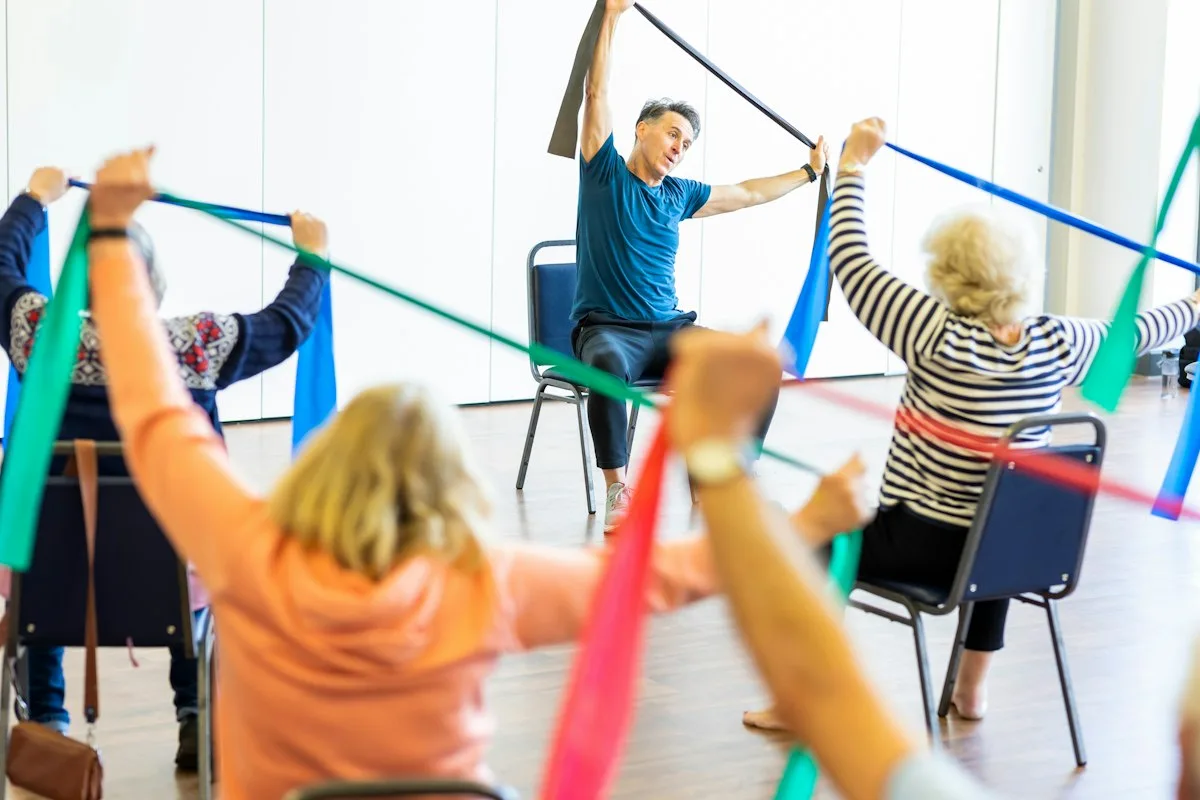
Strengthening exercises target the muscles that support painful joints. NIAMS suggests weights or exercise bands. The CDC adds that you should choose loads that do not cause joint pain and increase difficulty in small steps as your body adapts.
3. Flexibility and range-of-motion exercises
Range of motion is how far a joint can normally move in each direction. These gentle movements reduce stiffness and help keep joints flexible. An Arthritis Foundation exercise brochure, reviewed by the American College of Rheumatology, suggests doing range-of-motion exercises every day, starting with your stiffest joints. Examples include slow head turns, seated knee lifts and reaching both arms forward and up.
4. Balance training
Balance and agility work helps with everyday tasks and steadiness on your feet. The federal guidelines note that physical activity lowers the risk of falls and fall-related injuries in older adults. Tai chi and yoga are both mentioned by NIAMS as movement that supports balance. The ACR/Arthritis Foundation guideline conditionally recommends balance exercises for hip or knee osteoarthritis and yoga for knee osteoarthritis.
A sample beginner week
The plan below is an example of how the official targets could fit into a week for someone just starting out. It is not a prescription. Check with your doctor or a physical therapist first, and start with as little as 5 minutes per session if that is what feels manageable.
| Day | Main activity | Daily extras |
|---|---|---|
| Monday | Walk, building toward about 30 minutes (can be split into shorter walks) | Range-of-motion routine |
| Tuesday | Strength session with bands or light weights | Range-of-motion routine |
| Wednesday | Swimming, water aerobics or stationary cycling, building toward about 30 minutes | Range-of-motion routine |
| Thursday | Tai chi or a gentle balance session | Range-of-motion routine |
| Friday | Strength session with bands or light weights, plus a short walk | Range-of-motion routine |
| Saturday | Walk, cycle or dance, building toward about 30 minutes | Range-of-motion routine |
| Sunday | Rest day or an easy, short stroll | Range-of-motion routine |
Once you reach roughly 30 minutes on five days, you will have hit the 150-minute aerobic goal. Strength work on two days covers the muscle-strengthening target. The Arthritis Foundation brochure suggests range-of-motion sets of 3 to 10 repetitions, done twice, each day.
Tips for sticking with it:
- Pick activities you enjoy. The CDC suggests choosing things that are easy to access, cause little or no pain and that you will keep doing.
- Cool down. The Arthritis Foundation brochure advises always cooling down after exercise.
- Follow your therapist’s plan. The NHS warns that doing too much too quickly, or the wrong type of exercise, may damage joints.
Pain, flares and knowing when to ease off
Expect some adjustment. According to the CDC, some pain, stiffness or swelling is normal after starting a new program, and joint pain from activity should improve over time as your body adapts.
A practical guide used by the Arthritis Foundation is the “two-hour pain rule.” Exercise may make your muscles sore, but if your arthritis pain is worse two hours after you finish than it was before, you probably did too much. Next time, shorten the session or lower the intensity.
| What you notice | What it may mean | What to do |
|---|---|---|
| Mild muscle soreness after a new activity | Normal adjustment to a new routine | Keep going at the same level; it should ease as you adapt |
| Some extra stiffness or swelling early on | Common when starting out, per the CDC | Stay with gentle activity and monitor whether it improves |
| Joint pain worse two hours after exercise | You may have overdone it | Cut back the time or intensity next session |
| Pain that does not improve over time | The activity or plan may not suit you | Contact your health care provider |
| Severe pain or other severe symptoms | Needs medical review | Stop and contact your health care provider |
Adjusting on flare days
During a flare, when symptoms are much worse than usual, the Arthritis Foundation describes finding a balance between activity and rest as especially important during a flare. Ways to scale back:
- Switch to gentle range-of-motion work. The Arthritis Foundation suggests moving joints through the fullest comfortable range, such as slowly raising and lowering your legs while seated.
- Pace yourself and stop if pain increases.
- Use heat or cold. The Arthritis Foundation notes heat can relax muscles and ease pain, while cold can reduce inflammation. It suggests no more than 15 minutes at a time, two to four times a day.
Gout attacks are different: the NHS advises resting and raising the limb and avoiding pressure on the joint. See our guide to gout causes, diet and prevention.
Structured programs: Walk With Ease and others
If you would rather not design a routine yourself, the CDC promotes several evidence-based programs for arthritis, many run by parks departments, YMCAs and community groups.
- Walk With Ease: a 6-week walking program. A CDC report states that it reduces pain and fatigue and improves function, strength, balance and walking pace in adults with arthritis. It can be done in a group or on your own with a self-guided version.
- EnhanceFitness: a group exercise program offered at YMCA and other community sites. The CDC says it has been shown to improve physical functioning, mood and social functioning.
- Others: the CDC also lists the Arthritis Foundation Exercise Program, Active Living Every Day, Fit & Strong! and the Chronic Disease Self-Management Program.
The CDC suggests calling the Arthritis Foundation Helpline (1-800-283-7800) for help finding or registering for a program in the U.S. Outside the U.S., ask your doctor or a physiotherapist about local group classes.
A physical therapist is another good starting point. NIAMS recommends consulting one to plan a safe program, and the NHS notes that a GP may refer you to a physiotherapist for a home exercise plan.
Safety checklist and when to see a doctor
NIAMS advises talking to your doctor before beginning any new exercise and starting slowly.
- Begin with short sessions, even 5 minutes, and build gradually.
- Choose low-impact activities that cause little or no pain.
- Limit repetitive movements such as frequent bending, as NIAMS suggests.
- Ask about assistive devices if needed. NIAMS mentions braces, canes and shoe inserts, and the NHS explains how to use a walking stick on the opposite side from the painful leg.
- Use the two-hour pain rule to check your dose.
Contact a health care provider if:
- Pain or other symptoms are severe.
- Joint pain from activity does not improve over time.
- A joint becomes suddenly hot, red and swollen, especially with fever or feeling unwell. The NHS says this combination can signal a joint infection and needs urgent advice.
- You are unsure which exercises are safe after surgery or with an inflammatory arthritis.
For knee-specific options beyond exercise, see what helps knee osteoarthritis.
Frequently asked questions
Is it safe to exercise if I have arthritis?
Yes, for most people. The CDC states plainly that physical activity is safe for people with arthritis. Start slowly and ask your doctor or a physical therapist for guidance.
What is the best exercise for arthritis?
There is no single best option. Official sources recommend a mix of low-impact aerobic activity, strengthening and range-of-motion work. The ACR/Arthritis Foundation guideline strongly recommends exercise in general and tai chi for hip and knee osteoarthritis. The best choice is one you can do regularly without increasing your pain.
How long should I exercise each day?
The weekly goal is at least 150 minutes of moderate activity, which works out to about 30 minutes on five days. You do not need to do it all at once. The CDC says 5 or 10 minutes at a time is beneficial, and you can start with as little as 5 minutes.
Should I exercise during a flare?
Usually you should scale back rather than push through. The Arthritis Foundation suggests gentle range-of-motion movement, pacing yourself and stopping if pain increases. Rest is also appropriate during a flare.
Is walking good for knee arthritis?
Walking is one of the joint-friendly activities named by the CDC and NIAMS, and Walk With Ease is built around it. If walking hurts, try shorter walks, flatter routes or water-based exercise, and ask a physical therapist for advice.
Related reading
- Knee osteoarthritis: what actually helps
- Osteoarthritis vs. rheumatoid arthritis
- Gout: causes, diet and prevention
- Exercise for weight loss
- Omega-3 for joint pain: what the evidence says
Sources
- CDC: About Physical Activity and Arthritis
- CDC: How CDC Improves Quality of Life for People With Arthritis
- CDC MMWR: Arthritis Awareness Month (2015)
- ODPHP: Top 10 Things to Know About the Second Edition of the Physical Activity Guidelines for Americans
- NIAMS: Osteoarthritis: Diagnosis, Treatment, and Steps to Take
- NIAMS: Living With Arthritis (PDF)
- NHS: Osteoarthritis treatment
- Arthritis Foundation: Tips for Managing an Arthritis Flare
- Arthritis Foundation: Exercise and Your Arthritis, Range of Motion brochure (PDF)
- APTA: Updated guideline for management of hand, hip, knee OA strongly recommends exercise-based approaches
- NHS: Gout
This article is for general information and is not medical advice. Talk to a doctor, dentist or pharmacist before making major changes to your diet, activity, oral care or medication, especially if you have a health condition, are pregnant, or take prescription medicines.